CFM50: Cubic Feet per Minute at 50 Pascals
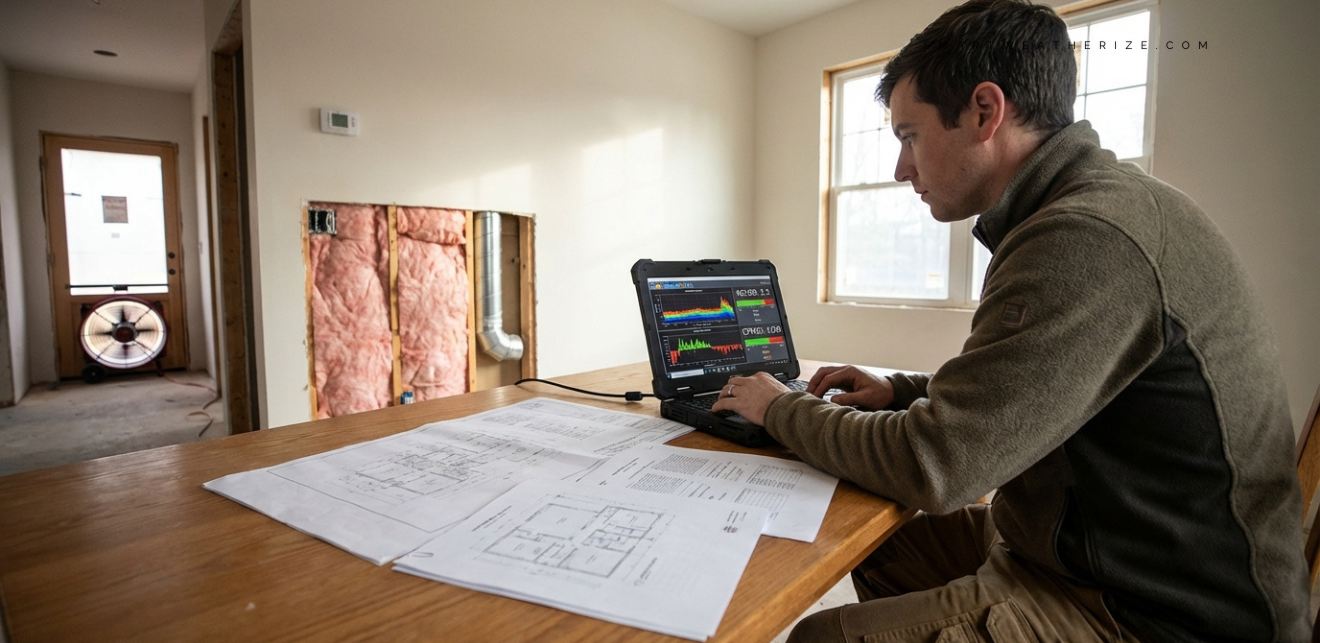
CFM50 is the raw airflow required to maintain a pressure difference of 50 Pa. It’s the unscaled “leakiness number.”
Higher CFM50 means more leakage. Lower CFM50 means a tighter building.
Most “drafty home” problems aren’t obvious. They hide behind trim, under attic hatches, around recessed lights, and in the tiny gaps where plumbing and wiring slip through your walls. You feel it as hot/cold rooms and higher bills, but you can’t point to one single cause.
A blower door test removes the guesswork. It turns your building’s airtightness into measurable results so you know exactly how leaky the envelope is and where improvements will actually matter.
Get My Blower Door Test & Results →
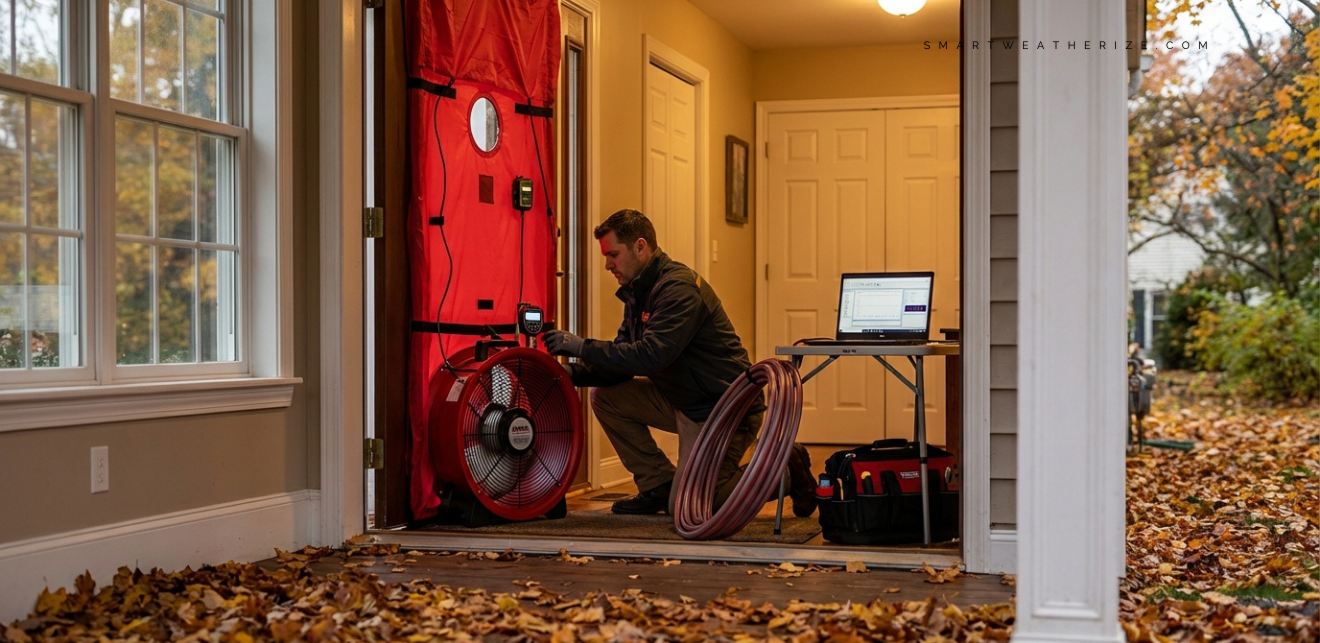
A blower door test measures how much air leaks into or out of a building. A large, calibrated fan is installed in an exterior doorway to create a pressure difference between indoors and outdoors. By measuring the airflow needed to maintain that pressure, the test reveals how airtight (or leaky) the building envelope is.
👉 Standard test pressure: 50 Pascals (Pa), roughly comparable to the pressure from a ~20 mph wind on a building’s surface.
Identifying hidden air leaks helps you prioritize weatherization improvements for real savings. See
Top Weatherization Techniques to Make Your Home Energy Efficient.
Sources:
Two key metrics summarize blower door results: CFM50 and ACH50. Together, they tell you how much air is leaking and how that leakage compares across buildings of different sizes.
CFM50 is the raw airflow required to maintain a pressure difference of 50 Pa. It’s the unscaled “leakiness number.”
Higher CFM50 means more leakage. Lower CFM50 means a tighter building.
ACH50 adjusts for building volume. It tells you how many times per hour the air in the building is exchanged due to leaks under test pressure.
Formula:
ACH50 = (CFM50 × 60) / conditioned volume (in cubic feet)
This is the best metric for comparing buildings of different sizes. The same leakage can be minor in a warehouse but serious in a small home.
Using a standardized test pressure of 50 Pa ensures results are consistent and comparable. It simulates the effect of strong wind on a building, so leaks that matter in real-world conditions become measurable.
Airtightness is a key building science principle: controlling airflow through the building envelope plays a major role in energy performance and indoor comfort.
The process is straightforward: a fan creates a controlled pressure difference, instruments measure airflow, and technicians locate the specific leakage pathways you can fix.
Testing can be done under depressurization (fan pulls air out) or pressurization (fan blows air in), depending on building type and protocol.
In professional weatherization, air sealing is foundational, and blower door testing verifies that leaks are actually sealed.
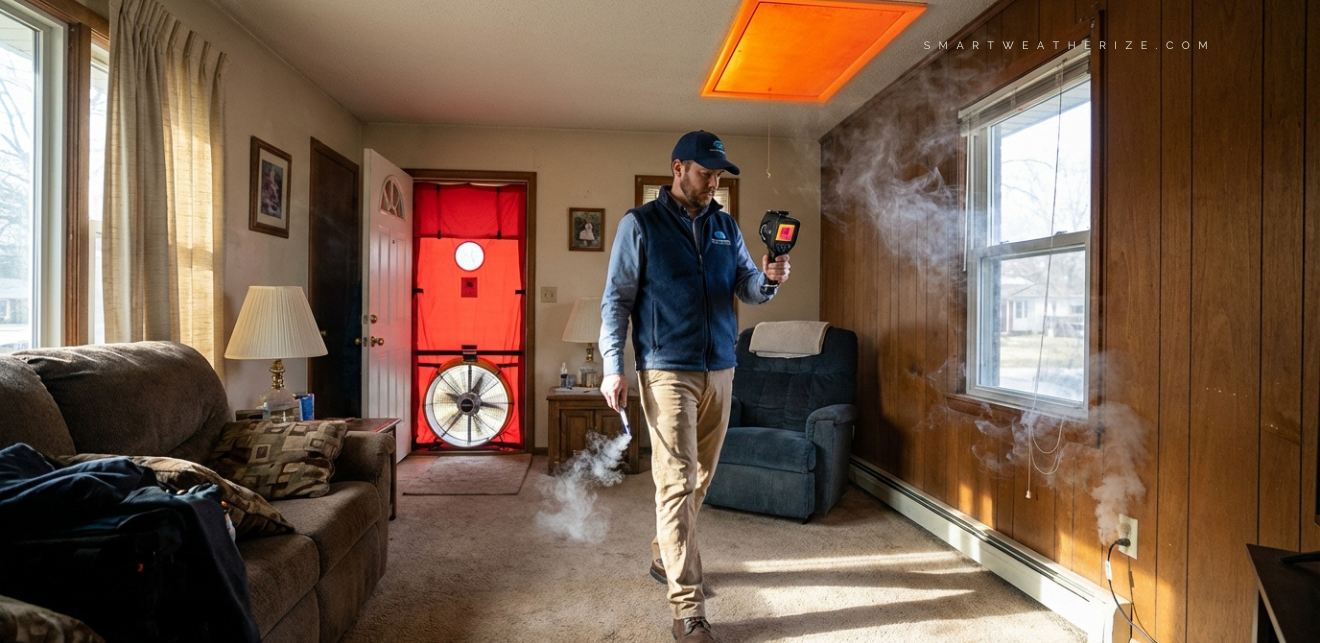
In homes, blower door testing typically measures whole-house leakage—how much air moves between inside and outside.
Many homeowners test to meet code, verify air sealing work, or diagnose comfort issues like drafts and uneven heating.
Code targets (IECC 2015): 5 ACH50 in Climate Zones 1–2, and 3 ACH50 in Zones 3–8.
See International Energy Conservation Code (IECC).
High-performance homes aiming for Passive House often target 0.6 ACH50 or lower.
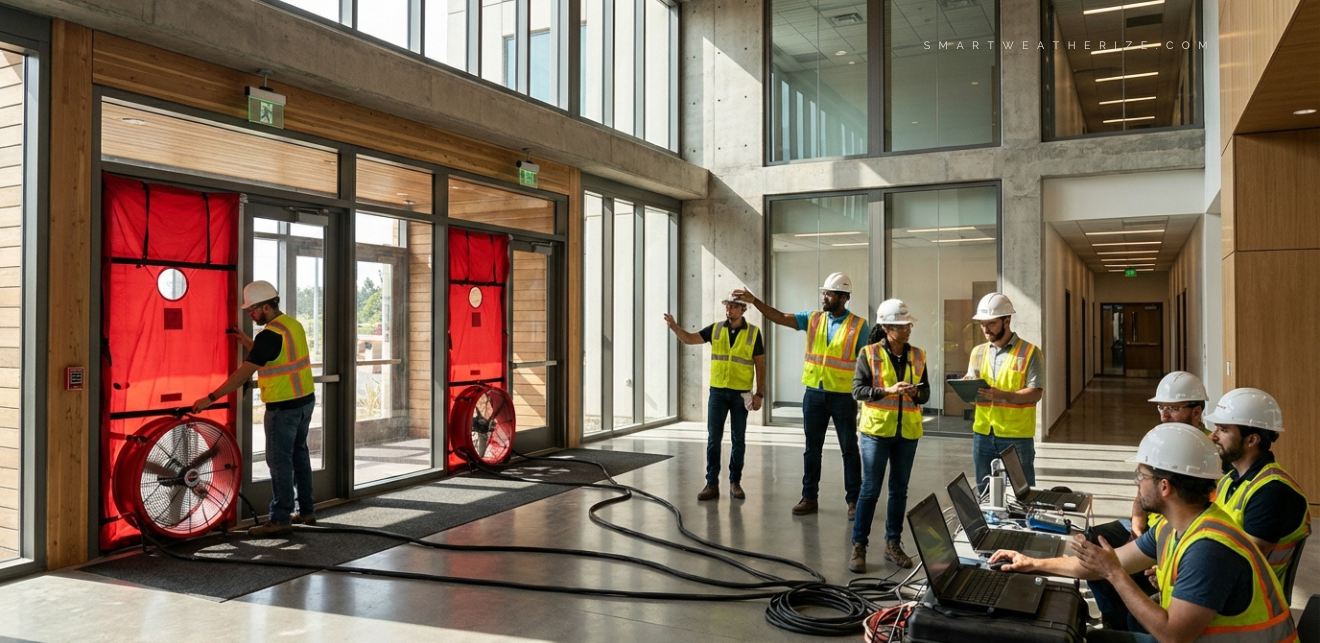
Apartments are more complex because air can leak to the outdoors or into hallways and neighboring units. That impacts comfort, privacy, and indoor air quality, which is why multifamily projects often emphasize compartmentalization testing and performance verification.
For large buildings, blower door testing may be performed as whole-building air leakage testing or air barrier testing. Teams often combine blower door results with other enclosure verification methods to meet ASTM-related standards or program requirements.
Whether you’re a builder, homeowner, or property manager, a blower door test delivers practical benefits you can feel and measure.
What is a blower door test?
A blower door test measures how airtight a building is by using a fan to pressurize or depressurize it. The airflow needed to maintain a set pressure reveals how much air is leaking.
What is a good ACH50 number?
Many homes are required to meet roughly ≤3 to 5 ACH50 depending on code and climate zone. High-performance buildings (like Passive House) often aim for ≤0.6 ACH50.
How long does a blower door test take?
Typically 1–2 hours, depending on building size and whether leak detection is included.
Can a blower door test detect mold or moisture issues?
Indirectly. While it doesn’t detect mold, it helps identify air leaks that can drive condensation and increase the risk of future moisture problems.
A blower door test is one of the most effective ways to assess a building’s energy performance and uncover hidden air leaks. From code compliance to Passive House targets, it provides measurable metrics—like CFM50 and ACH50—that guide smarter design, better construction, and more comfortable living.
If you’re planning air sealing, insulation, or renovations, testing first helps you spend money in the right places. If you’re chasing comfort issues, testing gives you proof of what’s really happening.